Responsibility of Family Members in the 50s in the Us
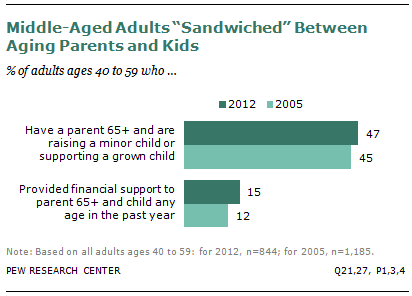 With an aging population and a generation of immature adults struggling to achieve fiscal independence, the burdens and responsibilities of eye-aged Americans are increasing. Well-nigh half (47%) of adults in their 40s and 50s have a parent age 65 or older and are either raising a young child or financially supporting a grown child (age 18 or older). And about 1-in-7 centre-aged adults (15%) is providing financial back up to both an crumbling parent and a child.
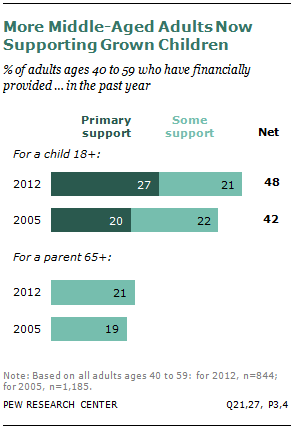 While the share of eye-aged adults living in the then-called sandwich generation has increased only marginally in recent years, the financial burdens associated with caring for multiple generations of family members are mounting. The increased pressure is coming primarily from grown children rather than aging parents.
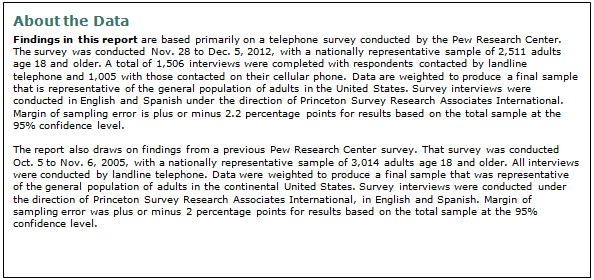
Co-ordinate to a new nationwide Pew Research Center survey, roughly half (48%) of adults ages 40 to 59 take provided some financial back up to at least one grown child in the past year, with 27% providing the master support. These shares are upwardly significantly from 2005. By contrast, about one-in-v heart-anile adults (21%) have provided fiscal support to a parent historic period 65 or older in the past twelvemonth, basically unchanged from 2005. The new survey was conducted Nov. 28-December. 5, 2012 amongst 2,511 adults nationwide.
Looking only at adults in their 40s and 50s who have at to the lowest degree one child age eighteen or older, fully 73% accept provided at least some financial help in the past twelvemonth to at least one such child. Many are supporting children who are withal in schoolhouse, only a significant share say they are doing so for other reasons. By contrast, among adults that age who have a parent age 65 or older, just 32% provided financial aid to a parent in the past year.
While middle-anile adults are devoting more than resources to their grown children these days, the survey finds that the public places more value on support for aging parents than on back up for grown children. Among all adults, 75% say adults have a responsibility to provide financial assistance to an elderly parent who is in demand; only 52% say parents have a like responsibility to support a grown kid.
One probable explanation for the increase in the prevalence of parents providing financial assistance to grown children is that the Great Recession and sluggish recovery have taken a asymmetric toll on young adults. In 2010, the share of young adults who were employed was the lowest it had been since the government started collecting these data in 1948. Moreover, from 2007 to 2011 those young adults who were employed full fourth dimension experienced a greater drop in average weekly earnings than whatever other historic period grouping.ane
A Contour of the Sandwich Generation
Adults who are office of the sandwich generation—that is, those who have a living parent age 65 or older and are either raising a child under age 18 or supporting a grown child—are pulled in many directions.ii Not but do many provide care and financial back up to their parents and their children, only nigh 4-in-ten (38%) say both their grown children and their parents rely on them for emotional support.
Who is the sandwich generation? Its members are more often than not center-anile: 71% of this group is ages 40 to 59. An boosted 19% are younger than 40 and 10% are historic period 60 or older. Men and women are equally likely to be members of the sandwich generation. Hispanics are more likely than whites or blacks to exist in this situation. Three-in-ten Hispanic adults (31%) have a parent age 65 or older and a dependent child. This compares with 24% of whites and 21% of blacks.
 More flush adults, those with almanac household incomes of $100,000 or more, are more likely than less affluent adults to be in the sandwich generation. Amid those with incomes of $100,000 or more, 43% have a living parent age 65 or older and a dependent child. This compares with 25% of those making between $thirty,000 and $100,000 a year and only 17% of those making less than $30,000.
Married adults are more likely than unmarried adults to be sandwiched between their parents and their children: 36% of those who are married fall into the sandwich generation, compared with 13% of those who are single. Age is a factor here as well, since young adults are both less likely to exist married and less probable to take a parent age 65 or older.
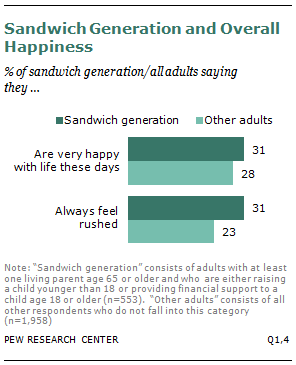
Presumably life in the sandwich generation could be a bit stressful. Having an aging parent while still raising or supporting one'due south own children presents sure challenges non faced by other adults—caregiving and financial and emotional support to proper name just a few. However, the survey suggests that adults in the sandwich generation are just equally happy with their lives overall as are other adults. Some 31% say they are very happy with their lives, and an additional 52% say they are pretty happy. Happiness rates are about the same amongst adults who are not office of the sandwich generation: 28% are very happy, and 51% are pretty happy.
Sandwich-generation adults are somewhat more likely than other adults to say they are often pressed for time. Among those with a parent age 65 or older and a dependent child, 31% say they always feel rushed even to do the things they have to exercise. Among other adults, the share saying they are always rushed is smaller (23%).
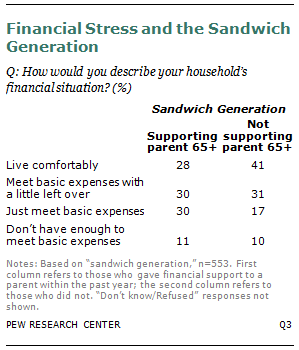 For members of the sandwich generation who not but have an aging parent but have also provided fiscal help to a parent, the strain of supporting multiple family members tin have an impact on financial well-beingness.3 Survey respondents were asked to draw their household's financial state of affairs. Among those who are providing financial support to an crumbling parent and supporting a child of whatever age, 28% say they alive comfortably, thirty% say they have enough to meet their basic expenses with a lilliputian left over for extras, thirty% say they are but able to see their basic expenses and eleven% say they don't have enough to meet fifty-fifty basic expenses. By contrast, 41% of adults who are sandwiched between children and aging parents, but not providing financial support to an aging parent, say they live comfortably.
Family Responsibilities
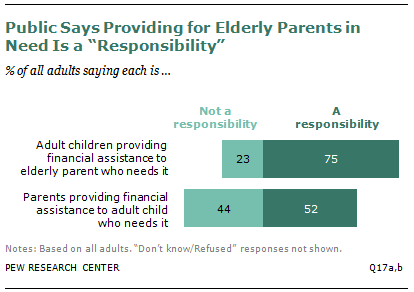 When survey respondents were asked if adult children take a responsibility to provide financial aid to an elderly parent in need, fully 75% say yes, they do. Just 23% say this is not an adult child's responsibility. By contrast, only most half of all respondents (52%) say parents accept a responsibility to provide financial assistance to a grown child if he or she needs it. Some 44% say parents do not have a responsibleness to do this.
When it comes to providing fiscal support to an aging parent in need, in that location is potent support across near major demographic groups. All the same, at that place are pregnant differences across age groups. Adults nether historic period 40 are the nigh likely to say an adult kid has a responsibility to support an elderly parent in need. 8-in-x in this age grouping (81%) say this is a responsibility, compared with 75% of middle-aged adults and 68% of those ages 60 or older. Adults who are already providing financial support to an aging parent are no more than likely than those who are non currently doing this to say this is responsibility.
On the question of whether parents have a responsibility to support their grown children, personal experience does seem to thing. Parents whose children are younger than 18 are less likely than those who take a child historic period eighteen or older to say that it is a parent's responsibleness to provide fiscal support to a grown child who needs information technology (46% vs. 56%). And those parents who are providing primary financial support to a grown kid are amidst the most likely to say this is a parent'southward responsibility (64%).
Financial Support for Aging Parents and Grown Children
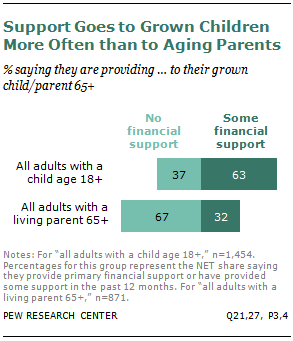 While most adults believe there is a responsibility to provide for an elderly parent in fiscal demand, about ane-in-four adults (23%) have actually done this in the past year. Among those who have at least one living parent historic period 65 or older, roughly one-3rd (32%) say they have given their parent or parents fiscal support in the past year. And for nigh, this is more than just a short-term delivery. About 7-in-ten (72%) of those who have given financial assistance to an crumbling parent say the coin was for ongoing expenses.
Similar shares of center-aged, younger and older adults say they have provided some financial support to their aging parents in the past year. It is worth noting that many parents age 65 or older may not be in need of financial assistance, so in that location is not necessarily a disconnect betwixt the share saying adult children have a responsibleness to provide for an aging parent who is in need and the share who have provided this type of support.
Overall, Americans are more likely to exist providing fiscal support to a grown child than they are to an aging parent. Amid all adults, 30% say they have given some type of financial back up to a grown child in the past yr. Amid those who have a grown kid, more than six-in-ten (63%) have done this.
Hither the brunt falls much more heavily on adults who are middle-aged than on their younger or older counterparts. Among adults ages twoscore to 59 with at least one grown kid, 73% say they have provided financial support in the by year. Amongst those ages lx and older with a grown kid, but about half (49%) say they have given that kid financial support. Very few of those under historic period 40 take a grown kid.
Of those center-aged parents who are providing financial assistance to a grown child, more than one-half say they are providing the primary support, while most 4-in-10 (43%) say they are non providing master support but accept given some financial support in the by 12 months. Some 62% of the parents providing primary support say they are doing so because their child is enrolled in schoolhouse. However, more than ane third (36%) say they are doing this for some other reason.
The focus in this report is on the financial flows from middle-anile adults to their aging parents and their grown children. Of class, money also flows from parents who are 65 or older to their centre-aged children. While the new Pew Enquiry survey did non explore these financial transfers, previous surveys accept establish that a meaning share of older adults provide financial assist to their grown children. A Pew Research survey conducted in Sept. 2011 plant that among adults 65 and older with at least one grown child age 25 or older, 44% said they had given financial support to a grown child in the past yr.4
Beyond Finances: Providing Intendance and Emotional Support
While some aging parents need financial support, others may as well need assistance with day-to-mean solar day living. Amid all adults with at least i parent age 65 or older, 30% say their parent or parents need help to handle their affairs or care for themselves; 69% say their parents can handle this on their own.
Middle-aged adults are the most likely to have a parent age 65 or older (68% say they practise). And of that group, 28% say their parent needs some help. Among those younger than 40, simply 18% have a parent age 65 or older; 20% of those ages lx and older accept a parent in that age group. Simply for those in their 60s and beyond who practice yet have a living parent, the likelihood that the parent will need caregiving is relatively high. Fully one-half of adults age 60 or older with a living parent say the parent needs aid with day-to-solar day living.
When aging adults demand assistance handling their affairs or caring for themselves, family members often assistance out. Amongst those with a parent age 65 or older who needs this blazon of assistance, 31% say they provide nigh of this help, and an additional 48% say they provide at to the lowest degree some of the help.
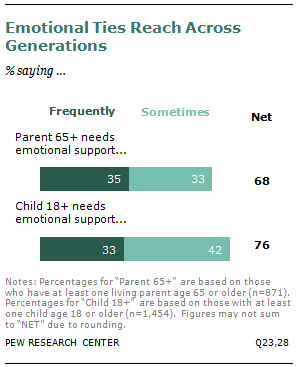
In addition to helping their aging parents with twenty-four hours-to-twenty-four hours living, many adults report that their parents rely on them for emotional support. Among all adults with a living parent historic period 65 or older, 35% say that their parent or parents oftentimes rely on them for emotional support, and 33% say their parents sometimes rely on them for emotional support. One-in-five say their parents hardly always rely on them in this style, and x% say they never exercise.
 Even amid those who say their parents exercise not demand aid treatment their affairs or caring for themselves, 61% say their parents rely on them for emotional support at least sometimes. For those whose parents exercise demand aid with daily living, fully 84% study that their parents rely on them for emotional support at least some of the time.
Not surprisingly, the older the parent, the more likely he or she is to require emotional support. Among adults with a parent age fourscore or older, 75% say their parents plough to them for emotional support frequently or sometimes. This compares with 64% among those who have a parent ages 65 to 79.
Emotional support also flows from parents to grown children, even children who are financially independent. Overall, 33% of parents with at least ane kid age 18 or older say their grown child or children depend on them frequently for emotional support. An additional 42% say their grown children sometimes rely on them for emotional support.
When it comes to grown children, there is a link between financial and emotional back up. Among parents who say they are providing primary financial support to their grown child or children, 43% say their children frequently rely on them for emotional support and 45% say they sometimes do. By comparison, only 24% of those who say they do non provide any financial back up to their grown children say their children frequently rely on them for emotional back up, and 39% say their children sometimes rely on them for this type of support.
Boomers Moving Out of the Sandwich Generation
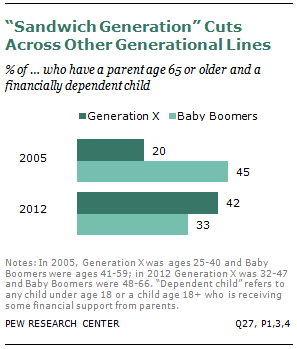 Today members of the Baby Boomer generation and Generation X are represented in the "sandwich generation." Merely the balance has shifted significantly. When the Pew Research Eye explored this topic in 2005, Baby Boomers made upwards the bulk of the sandwich generation. They were more than than twice as likely as members of the next generation—Generation X—to have a parent age 65 or older and exist supporting a child (45% vs. 20%). Since 2005, many Babe Boomers have anile out of the sandwich generation, and today adults who are role of Generation X are more likely than Baby Boomers to discover themselves in this situation: 42% of Gen Xers have parent age 65 or older and a dependent child, compared with 33% of Boomers.5
This study will focus largely on adults ages 40 to 59, loosely defined as "middle aged." While this group may not share a generational characterization, many of its members do have a shared set of experiences, challenges and responsibilities given the unique position they inhabit, sandwiched between their children and their aging parents.
Centre-aged adults who make up the cadre of the sandwich generation are living out these challenges and, in the procedure, possibly ushering in a new set of family dynamics. Most middle-aged parents with grown children say their relationship with their children is different from the relationship they had with their own parents at a comparable age. Half say the relationship is closer, while 12% say it's less close and 37% say the relationship is virtually the same. Older adults (those ages 60 and older) are less probable than centre-aged parents to say they have a closer relationship with their grown children than they had with their own parents (44%), and they are more likely to say the relationship is about the aforementioned (45%).
The rest of this written report will look at the basic edifice blocks of intergenerational relationships in more detail. The get-go department volition look at attitudes about financial responsibilities and the reality of financial transfers. The second department will expect at caregiving for older adults. How many older adults need assistance with day-to-day living, and who is providing that care? The third section volition look at emotional ties beyond generations and explore the extent to which aging parents rely on their children and grown children rely on their parents for emotional support.
thorntonthroplad1935.blogspot.com
Source: https://www.pewresearch.org/social-trends/2013/01/30/the-sandwich-generation/

Post a Comment for "Responsibility of Family Members in the 50s in the Us"