What Is the Probability That Exactly Four Children Were in a Family
Probability issues are notorious for yielding surprising and counterintuitive results. One famous example--or a pair of examples--is the following:
A couple has 2 children and the older kid is a boy. If the probabilities of having a male child or a girl are both 50%, what'south the probability that the couple has 2 boys?
We already know that the older child is a boy. The probability of two boys is equivalent to the probability that the younger child is a boy, which is .A couple has ii children, of which at least i is a boy. If the probabilities of having a boy or a girl are both , what is the probability that the couple has 2 boys?
At starting time glance, this appears to be request the same question. We might reason as follows: "Nosotros know that one is a male child, and then the just question is whether the other ane is a boy, and the chances of that existence the case are . And so again, the reply is ."
This makes perfect sense. It also happens to be incorrect.
Bayes' theorem centers on relating dissimilar provisional probabilities. A provisional probability is an expression of how probable one result is given that another event occurred (a fixed value). For instance, "what is the probability that the sidewalk is wet?" volition have a different answer than "what is the probability that the sidewalk is moisture given that it rained earlier?"
For a joint probability distribution over events and , , the conditional probability of given is defined equally
In the sidewalk example, where is "the sidewalk is wet" and is "information technology rained earlier," this expression reads every bit "the probability the sidewalk is wet given that it rained earlier is equal to the probability that the sidewalk is wet and it rains over the probability that information technology rains."
Note that is the probability of both and occurring, which is the same as the probability of occurring times the probability that occurs given that occurred: Using the same reasoning, is also the probability that occurs times the probability that occurs given that occurs: . The fact that these two expressions are equal leads to Bayes' Theorem. Expressed mathematically, this is:
Discover that our result for dependent events and for Bayes' theorem are both valid when the events are independent. In these instances, and , so the expressions simplify.
Bayes' Theorem
While this is an equation that applies to any probability distribution over events and , information technology has a particularly squeamish interpretation in the case where represents a hypothesis and represents some observed evidence . In this case, the formula tin exist written as
This relates the probability of the hypothesis before getting the evidence , to the probability of the hypothesis after getting the evidence, . For this reason, is called the prior probability, while is chosen the posterior probability. The factor that relates the two, , is called the likelihood ratio. Using these terms, Bayes' theorem can be rephrased as "the posterior probability equals the prior probability times the likelihood ratio."
If a single card is fatigued from a standard deck of playing cards, the probability that the bill of fare is a king is 4/52, since there are 4 kings in a standard deck of 52 cards. Rewording this, if is the upshot "this card is a king," the prior probability
If evidence is provided (for instance, someone looks at the card) that the single card is a face menu, then the posterior probability can be calculated using Bayes' theorem:
Since every King is also a face up card, . Since there are 3 face cards in each conform (Jack, Queen, King) , the probability of a face carte is . Combining these gives a likelihood ratio of .
Using Bayes' theorem gives .
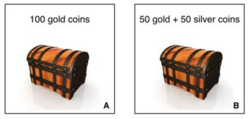 Y'all randomly choose a treasure chest to open, and and then randomly choose a money from that treasure breast. If the coin you choose is aureate, then what is the probability that yous chose chest A?
Bayes' theorem clarifies the two-children problem from the first section:
1. A couple has two children, the older of which is a boy. What is the probability that they have 2 boys?
2. A couple has two children, 1 of which is a boy. What is the probability that they have two boys?
Define three events, , , and , equally follows:
Question 1 is asking for , and Question 2 is request for . The first is computed using the simpler version of Bayes' theorem:
To find , we must decide , the prior probability that the couple has at least one male child. This is equal to . Therefore the desired probability is
For a similarly paradoxical problem, run across the Monty Hall problem.
Venn diagrams are particularly useful for visualizing Bayes' theorem, since both the diagrams and the theorem are virtually looking at the intersections of different spaces of events.
A disease is present in 5 out of 100 people, and a examination that is ninety% accurate (pregnant that the test produces the correct outcome in 90% of cases) is administered to 100 people. If i person in the group tests positive, what is the probability that this one person has the disease?
The intuitive answer is that the 1 person is 90% likely to have the affliction. Only we can visualize this to show that it's not authentic. First, draw the full population and the 5 people who have the disease:

The circle A represents five out 100, or five% of the larger universe of 100 people.
Adjacent, overlay a circumvolve to represent the people who get a positive effect on the test. Nosotros know that ninety% of those with the disease volition get a positive result, so demand to embrace 90% of circle A, but we besides know that ten% of the population who does not have the illness will get a positive outcome, and so we need to cover 10% of the non-disease carrying population (the total universe of 100 less circle A).

Circumvolve B is covering a substantial portion of the total population. It actually covers more surface area than the full portion of the population with the disease. This is because 14 out of the full population of 100 (90% of the five people with the disease + 10% of the 95 people without the illness) volition receive a positive result. Even though this is a test with 90% accuracy, this visualization shows that any one patient who tests positive (Circle B) for the affliction only has a 32.14% (4.5 in 14) run a risk of actually having the disease.
Chief commodity: Bayesian theory in science and math
Bayes' theorem can show the likelihood of getting false positives in scientific studies. An in-depth look at this can be found in Bayesian theory in science and math.
Many medical diagnostic tests are said to be % authentic, for example 99% accurate, referring specifically to the probability that the test event is correct given your status (or lack thereof). This is not the same as the posterior probability of having the disease given the result of the examination. To see this in activity, consider the following problem.

The world had been harmed by a widespread Z-virus, which already turned ten% of the world's population into zombies.
The scientists then invented a test kit with the sensitivity of 90% and specificity of 70%: 90% of the infected people will be tested positive while lxx% of the non-infected will be tested negative.
If the examination kit showed a positive result, what would exist the probability that the tested subject was truly zombie?
If the solution is in a form of , where and are coprime positive integers, submit your answer every bit .

A disease test is advertised as beingness 99% accurate: if y'all have the disease, you will test positive 99% of the time, and if you don't have the disease, yous will test negative 99% of the time.
If 1% of all people have this illness and you test positive, what is the probability that you actually take the disease?
Balls numbered i through 20 are placed in a handbag. Three balls are drawn out of the handbag without replacement. What is the probability that all the balls have odd numbers on them?
In this situation, the events are not independent. There volition be a chance that any detail brawl is odd. However, the probability that all the assurance are odd is not . We do take that the probability that the first ball is odd is For the 2nd brawl, given that the get-go ball was odd, there are simply ix odd numbered balls that could exist drawn from a full of 19 balls, so the probability is . For the third ball, since the kickoff ii are both odd, there are 8 odd numbered balls that could exist drawn from a total of xviii remaining balls. So the probability is .
So the probability that all 3 balls are odd numbered is Notice that , whereas
A family unit has 2 children. Given that one of the children is a boy, what is the probability that both children are boys?
We assume that the probability of a child beingness a boy or girl is . We solve this using Bayes' theorem. We let be the event that the family has ane child who is a boy. We let be the effect that both children are boys. Nosotros desire to find . We can hands come across that . We likewise note that and . So .
A family has ii children. Given that one of the children is a boy, and that he was born on a Tuesday, what is the probability that both children are boys?
Your first instinct to this question might exist to answer , since this is evidently the aforementioned question as the previous ane. Knowing the mean solar day of the week a kid is born on tin't maybe give you additional information, right?
Let's presume that the probability of existence born on a detail day of the week is and is independent of whether the child is a boy or a daughter. We let be the result that the family has one child who is a boy built-in on Tuesday and be the result that both children are boys, and employ Bayes' Theorem. We discover right away that is no longer equal to one. Given that in that location are vii days of the week, there are 49 possible combinations for the days of the week the two boys were born on, and 13 of these take a male child who was built-in on a Tuesday, so . remains unchanged at . To calculate , we annotation that in that location are possible ways to select the gender and the day of the week the child was born on. Of these, there are ways which do non take a boy born on Tuesday, and which practice, so . This gives is that .
Annotation: This respond is certainly not , and is actually much closer to .
 Zeb's money box contains 8 fair, standard coins (heads and tails) and one coin which has heads on both sides. He selects a money randomly and flips it 4 times, getting all heads. If he flips this money again, what is the probability information technology will exist heads? (The respond value will exist from 0 to 1, not as a percent.)

In that location are 10 boxes containing blue and ruby balls.
The number of blue assurance in the box is given by .
The number of scarlet balls in the box is given by .
A box is picked at random, and a ball is chosen randomly from that box. If the brawl is blue, and the probability that the box was picked tin exist expressed as , where and are coprime positive integers, find .
More probability questions
Photograph credit: http://www.spi-global.com/
thorntonthroplad1935.blogspot.com
Source: https://brilliant.org/wiki/bayes-theorem/

Post a Comment for "What Is the Probability That Exactly Four Children Were in a Family"