Clip Art Pictures of Fruit Spilled Apples Black and

January Brueghel the Elderberry (1568–1625), Bouquet (1599). Some of the primeval examples of even so life were paintings of flowers past Netherlandish Renaissance painters. All the same-life painting (including vanitas), as a particular genre, achieved its greatest importance in the Gilt Historic period of Netherlandish art (ca. 1500s–1600s).

A still life (plural: nonetheless lifes) is a work of fine art depicting mostly inanimate subject field matter, typically commonplace objects which are either natural (food, flowers, dead animals, plants, rocks, shells, etc.) or man-made (drinking spectacles, books, vases, jewelry, coins, pipes, etc.).[1]
With origins in the Middle Ages and Ancient Greco-Roman fine art, however-life painting emerged as a distinct genre and professional specialization in Western painting by the belatedly 16th century, and has remained significant since so. One advantage of the nevertheless-life artform is that it allows an artist much freedom to experiment with the arrangement of elements within a composition of a painting. Still life, every bit a particular genre, began with Netherlandish painting of the 16th and 17th centuries, and the English term still life derives from the Dutch word stilleven. Early on still-life paintings, particularly before 1700, often contained religious and allegorical symbolism relating to the objects depicted. Later even so-life works are produced with a multifariousness of media and technology, such equally found objects, photography, computer graphics, as well as video and sound.
The term includes the painting of dead animals, specially game. Live ones are considered creature art, although in practise they were often painted from dead models. Considering of the utilise of plants and animals as a subject, the withal-life category also shares commonalities with zoological and especially botanical illustration. All the same, with visual or fine art, the piece of work is non intended merely to illustrate the subject field correctly.
Notwithstanding life occupied the lowest rung of the bureaucracy of genres, but has been extremely popular with buyers. Also as the independent nevertheless-life subject field, still-life painting encompasses other types of painting with prominent all the same-life elements, normally symbolic, and "images that rely on a multitude of still-life elements ostensibly to reproduce a 'slice of life'".[2] The trompe-l'œil painting, which intends to deceive the viewer into thinking the scene is real, is a specialized type of still life, unremarkably showing inanimate and relatively flat objects.[three]
Antecedents and development [edit]
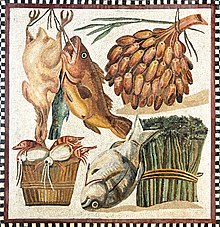
Nonetheless life on a 2nd-century mosaic, with fish, poultry, dates and vegetables from the Vatican museum

Still-life paintings often adorn the interior of ancient Egyptian tombs. It was believed that food objects and other items depicted there would, in the afterlife, go real and available for use past the deceased. Ancient Greek vase paintings too demonstrate groovy skill in depicting everyday objects and animals. Peiraikos is mentioned by Pliny the Elder as a panel painter of "depression" subjects, such as survive in mosaic versions and provincial wall-paintings at Pompeii: "barbers' shops, cobblers' stalls, asses, eatables and like subjects".[4]
Like all the same life, more simply decorative in intent, but with realistic perspective, have also been found in the Roman wall paintings and flooring mosaics unearthed at Pompeii, Herculaneum and the Villa Boscoreale, including the afterward familiar motif of a glass bowl of fruit. Decorative mosaics termed "emblema", found in the homes of rich Romans, demonstrated the range of food enjoyed by the upper classes, and also functioned as signs of hospitality and every bit celebrations of the seasons and of life.[5]
By the 16th century, food and flowers would again announced equally symbols of the seasons and of the 5 senses. Likewise starting in Roman times is the tradition of the use of the skull in paintings every bit a symbol of mortality and earthly remains, often with the accompanying phrase Omnia mors aequat (Death makes all equal).[half-dozen] These vanitas images have been re-interpreted through the last 400 years of art history, starting with Dutch painters effectually 1600.[vii]
The popular appreciation of the realism of still-life painting is related in the ancient Greek fable of Zeuxis and Parrhasius, who are said to take once competed to create the well-nigh lifelike objects, history'southward earliest descriptions of trompe-l'œil painting.[8] Every bit Pliny the Elderberry recorded in ancient Roman times, Greek artists centuries earlier were already advanced in the arts of portrait painting, genre painting and notwithstanding life. He singled out Peiraikos, "whose artistry is surpassed by only a very few...He painted barbershops and shoemakers' stalls, donkeys, vegetables, and such, and for that reason came to be called the 'painter of vulgar subjects'; yet these works are altogether delightful, and they were sold at higher prices than the greatest [paintings] of many other artists."[9]
Middle Ages and Early Renaissance [edit]

Hans Memling (1430–1494), Vase of Flowers (1480), Museo Thyssen-Bornemisza, Madrid. According to some scholars the Vase of Flowers is filled with religious symbolism.[10]
By 1300, starting with Giotto and his pupils, still-life painting was revived in the form of fictional niches on religious wall paintings which depicted everyday objects.[xi] Through the Middle Ages and the Renaissance, still life in Western art remained primarily an adjunct to Christian religious subjects, and convened religious and allegorical pregnant. This was specially true in the work of Northern European artists, whose fascination with highly detailed optical realism and symbolism led them to lavish great attention on their paintings' overall message.[12] Painters like Jan van Eyck often used still-life elements as function of an iconographic plan.[ commendation needed ]
In the late Middle Ages, still-life elements, mostly flowers merely also animals and sometimes inanimate objects, were painted with increasing realism in the borders of illuminated manuscripts, developing models and technical advances that were used by painters of larger images. At that place was considerable overlap between the artists making miniatures for manuscripts and those painting panels, especially in Early Netherlandish painting. The Hours of Catherine of Cleves, probably fabricated in Utrecht around 1440, is one of the outstanding examples of this trend, with borders featuring an extraordinary range of objects, including coins and fishing-nets, chosen to complement the text or main epitome at that particular point. Flemish workshops after in the century took the naturalism of border elements fifty-fifty further. Gothic millefleur tapestries are some other case of the general increasing interest in accurate depictions of plants and animals. The set of The Lady and the Unicorn is the best-known example, designed in Paris around 1500 and then woven in Flemish region.[ citation needed ]
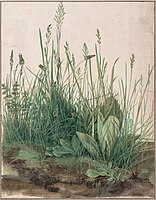
The evolution of oil painting technique by Jan van Eyck and other Northern European artists made information technology possible to paint everyday objects in this hyper-realistic fashion, attributable to the boring drying, mixing, and layering qualities of oil colours.[13] Among the get-go to break complimentary of religious pregnant were Leonardo da Vinci, who created watercolour studies of fruit (around 1495) as role of his restless examination of nature, and Albrecht Dürer who also made precise coloured drawings of flora and animal.[14]
Petrus Christus' portrait of a bride and groom visiting a goldsmith is a typical example of a transitional nonetheless life depicting both religious and secular content. Though mostly emblematic in message, the figures of the couple are realistic and the objects shown (coins, vessels, etc.) are accurately painted but the goldsmith is actually a depiction of St. Eligius and the objects heavily symbolic. Another similar type of painting is the family portrait combining figures with a well-set tabular array of food, which symbolizes both the piety of the human subjects and their thanks for God's abundance.[15] Around this fourth dimension, unproblematic still-life depictions divorced of figures (but not allegorical pregnant) were start to be painted on the outside of shutters of private devotional paintings.[9] Some other pace toward the autonomous still life was the painting of symbolic flowers in vases on the back of secular portraits effectually 1475.[16] Jacopo de' Barbari went a step farther with his Still Life with Partridge and Gauntlets (1504), among the earliest signed and dated trompe-l'œil withal-life paintings, which contains minimal religious content.[17]

After Renaissance [edit]

Sixteenth century [edit]
Though nigh still lifes after 1600 were relatively small paintings, a crucial phase in the evolution of the genre was the tradition, mostly centred on Antwerp, of the "monumental still life", which were large paintings that included great spreads of even so-life material with figures and often animals. This was a development past Pieter Aertsen, whose A Meat Stall with the Holy Family Giving Alms (1551, now Uppsala) introduced the type with a painting that yet startles. Another example is "The Butcher Shop" by Aertsen's nephew Joachim Beuckelaer (1568), with its realistic depiction of raw meats dominating the foreground, while a background scene conveys the dangers of drunkenness and lechery. The type of very big kitchen or market scene developed by Pieter Aertsen and his nephew Joachim Beuckelaer typically depicts an abundance of food with a kitchenware still life and burly Flemish kitchen-maids. A small religious scene can frequently be made out in the distance, or a theme such as the Four Seasons is added to elevate the subject. This sort of big-calibration however life connected to develop in Flemish painting later on the separation of the North and South, but is rare in Dutch painting, although other works in this tradition conceptualize the "merry company" type of genre painting.[eighteen]
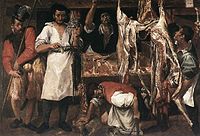
Gradually, religious content diminished in size and placement in this type of painting, though moral lessons continued as sub-contexts.[19] Ane of the relatively few Italian works in the manner, Annibale Carracci's treatment of the same subject in 1583, Butcher'southward Shop, begins to remove the moral messages, as did other "kitchen and market place" still-life paintings of this period.[20] Vincenzo Campi probably introduced the Antwerp mode to Italia in the 1570s. The tradition continued into the side by side century, with several works by Rubens, who more often than not sub-contracted the nevertheless-life and animal elements to specialist masters such every bit Frans Snyders and his student Jan Fyt. By the second one-half of the 16th century, the democratic withal life evolved.[21]

The 16th century witnessed an explosion of interest in the natural globe and the creation of lavish botanical encyclopædias recording the discoveries of the New World and Asia. It likewise prompted the beginning of scientific analogy and the classification of specimens. Natural objects began to exist appreciated as individual objects of study autonomously from whatever religious or mythological associations. The early science of herbal remedies began at this time equally well, which was a practical extension of this new knowledge. In addition, wealthy patrons began to underwrite the collection of animal and mineral specimens, creating extensive cabinets of curiosities. These specimens served as models for painters who sought realism and novelty. Shells, insects, exotic fruits and flowers began to be nerveless and traded, and new plants such equally the tulip (imported to Europe from Turkey), were celebrated in still-life paintings.[22]
The horticultural explosion was of widespread involvement in Europe and artist capitalized on that to produce thousands of still-life paintings. Some regions and courts had detail interests. The depiction of citrus, for example, was a item passion of the Medici court in Florence, Italy.[23] This great improvidence of natural specimens and the burgeoning interest in natural illustration throughout Europe, resulted in the nearly simultaneous creation of modern still-life paintings around 1600.[24] [25]
At the plough of the century the Spanish painter Juan Sánchez Cotán pioneered the Spanish still life with austerely tranquil paintings of vegetables, earlier entering a monastery in his forties in 1603, afterward which he painted religious subjects.[ commendation needed ]
Sixteenth-century paintings [edit]
-
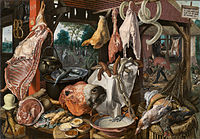
Pieter Aertsen, A Meat Stall with the Holy Family Giving Alms (1551), 123.iii × 150 cm (48.5 × 59")
-
-
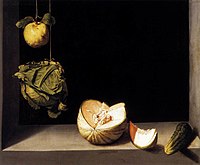
Juan Sánchez Cotán (1560–1627), Even so life with Quince, Cabbage, Melon and Cucumber, oil on canvass, 69 × 84.five cm
-

Giovanni Ambrogio Figino, Metal Plate with Peaches and Vine Leaves (1591–94), console, 21 × thirty cm, his only known still life
Seventeenth century [edit]

Prominent Academicians of the early 17th century, such as Andrea Sacchi, felt that genre and withal-life painting did non carry the "gravitas" merited for painting to be considered great. An influential formulation of 1667 by André Félibien, a historiographer, architect and theoretician of French classicism became the classic statement of the theory of the hierarchy of genres for the 18th century:
Celui qui fait parfaitement des païsages est au-dessus d'un autre qui ne fait que des fruits, des fleurs ou des coquilles. Celui qui peint des animaux vivants est plus estimable que ceux qui ne représentent que des choses mortes & sans mouvement ; & comme la effigy de l'homme est le plus parfait ouvrage de Dieu sur la Terre, il est certain aussi que celui qui se rend 50'imitateur de Dieu en peignant des figures humaines, est beaucoup plus excellent que tous les autres ...[26]
He who produces perfect landscapes is higher up another who only produces fruit, flowers or seafood. He who paints living animals is more estimable than those who only represent dead things without motility, and as man is the most perfect work of God on the earth, it is also certain that he who becomes an imitator of God in representing human figures, is much more fantabulous than all the others ...".
Dutch and Flemish painting [edit]
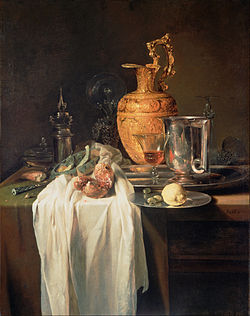

Pieter Claesz (1597–1660), Notwithstanding life with Musical Instruments (1623)
Still life developed every bit a split up category in the Low Countries in the last quarter of the 16th century.[27] The English term still life derives from the Dutch word stilleven while Romance languages (as well as Greek, Shine, Russian and Turkish) tend to utilise terms meaning expressionless nature. 15th-century Early on Netherlandish painting had developed highly illusionistic techniques in both panel painting and illuminated manuscripts, where the borders often featured elaborate displays of flowers, insects and, in a work like the Hours of Catherine of Cleves, a neat multifariousness of objects. When the illuminated manuscript was displaced by the printed volume, the same skills were later deployed in scientific botanical illustration; the Depression Countries led Europe in both botany and its depiction in fine art. The Flemish creative person Joris Hoefnagel (1542–1601) made watercolour and gouache paintings of flowers and other still-life subjects for the Emperor Rudolf II, and there were many engraved illustrations for books (often then hand-coloured), such every bit Hans Collaert's Florilegium, published by Plantin in 1600.[28]
Effectually 1600 flower paintings in oils became something of a craze; Karel van Mander painted some works himself, and records that other Northern Mannerist artists such as Cornelis van Haarlem also did so. No surviving blossom-pieces by them are known, just many survive by the leading specialists, January Brueghel the Elder and Ambrosius Bosschaert, both active in the Southern Netherlands.[29]
While artists in the North found express opportunity to produce the religious iconography which had long been their staple—images of religious subjects were forbidden in the Dutch Reformed Protestant Church—the continuing Northern tradition of detailed realism and hidden symbols appealed to the growing Dutch middle classes, who were replacing Church and State as the principal patrons of art in the Netherlands. Added to this was the Dutch mania for horticulture, specially the tulip. These two views of flowers—equally aesthetic objects and as religious symbols— merged to create a very strong market place for this type of still life.[30] Notwithstanding life, similar most Dutch art work, was generally sold in open markets or by dealers, or by artists at their studios, and rarely commissioned; therefore, artists usually chose the field of study matter and arrangement.[31] So pop was this type of still-life painting, that much of the technique of Dutch flower painting was codified in the 1740 treatise Groot Schilderboeck by Gerard de Lairesse, which gave broad-ranging advice on colour, arranging, brushwork, training of specimens, harmony, composition, perspective, etc.[32]
The symbolism of flowers had evolved since early on Christian days. The most common flowers and their symbolic meanings include: rose (Virgin Mary, transience, Venus, beloved); lily (Virgin Mary, virginity, female breast, purity of mind or justice); tulip (showiness, dignity); sunflower (faithfulness, divine dearest, devotion); violet (modesty, reserve, humility); columbine (melancholy); poppy (ability, sleep, expiry). As for insects, the butterfly represents transformation and resurrection while the dragonfly symbolizes transience and the ant difficult work and attention to the harvest.[33]
Flemish and Dutch artists also branched out and revived the aboriginal Greek still life tradition of trompe-fifty'œil, particularly the imitation of nature or mimesis, which they termed bedriegertje ("little deception").[8] In add-on to these types of still life, Dutch artists identified and separately developed "kitchen and market" paintings, breakfast and food table withal life, vanitas paintings, and allegorical drove paintings.[34]
In the Catholic Southern Netherlands the genre of garland paintings was developed. Around 1607–1608, Antwerp artists January Brueghel the Elder and Hendrick van Balen started creating these pictures which consist of an image (commonly devotional) which is encircled past a lush still life wreath. The paintings were collaborations betwixt two specialists: a still life and a figure painter. Daniel Seghers developed the genre further. Originally serving a devotional role, garland paintings became extremely pop and were widely used as decoration of homes.[35]
A special genre of still life was the so-called pronkstilleven (Dutch for 'ostentatious still life'). This style of ornate nonetheless-life painting was developed in the 1640s in Antwerp past Flemish artists such as Frans Snyders and Adriaen van Utrecht. They painted yet lifes that emphasized abundance by depicting a diversity of objects, fruits, flowers and expressionless game, often together with living people and animals. The mode was soon adopted by artists from the Dutch Republic.[36]
Especially popular in this menses were vanitas paintings, in which sumptuous arrangements of fruit and flowers, books, statuettes, vases, coins, jewelry, paintings, musical and scientific instruments, military insignia, fine argent and crystal, were accompanied by symbolic reminders of life'south impermanence. Additionally, a skull, an hourglass or pocket watch, a candle burning downwardly or a book with pages turning, would serve as a moralizing message on the ephemerality of sensory pleasures. Often some of the fruits and flowers themselves would be shown starting to spoil or fade to emphasize the same betoken.[ citation needed ]
-

-
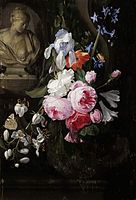
-

January Jansz. Treck (1606–1652), Still Life Pewter Jug and Two Porcelain Plates (1645)
Another blazon of all the same life, known as ontbijtjes or "breakfast paintings", represent both a literal presentation of delicacies that the upper class might bask and a religious reminder to avoid gluttony.[37] Around 1650 Samuel van Hoogstraten painted one of the showtime wall-rack pictures, trompe-l'œil still-life paintings which feature objects tied, tacked or attached in some other manner to a wall board, a type of still life very popular in the United states of america in the 19th century.[38] Another variation was the trompe-fifty'œil nonetheless life depicted objects associated with a given profession, every bit with the Cornelis Norbertus Gysbrecht's painting "Painter's Easel with Fruit Piece", which displays all the tools of a painter's craft.[39] Also popular in the offset half of the 17th century was the painting of a large assortment of specimens in allegorical class, such as the "five senses", "iv continents", or "the four seasons", showing a goddess or allegorical effigy surrounded by appropriate natural and man-made objects.[forty] The popularity of vanitas paintings, and these other forms of yet life, soon spread from Kingdom of the netherlands to Flemish region and Federal republic of germany, and too to Kingdom of spain[41] and France.
The Netherlandish production of withal lifes was enormous, and they were very widely exported, especially to northern Europe; Britain inappreciably produced any itself. German withal life followed closely the Dutch models; Georg Flegel was a pioneer in pure withal life without figures and created the compositional innovation of placing detailed objects in cabinets, cupboards, and display cases, and producing simultaneous multiple views.[42]
Dutch, Flemish, German and French paintings [edit]
-

Peter Paul Rubens, Diana Returning from the Hunt, yet life elements by a specialist (c. 1615)
-
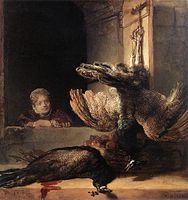
Rembrandt, Still-Life with Two Dead Peacocks and a Girl (c. 1639)
-

Pieter Boel (1626–1674), Still Life with a Globe and a Parrot (c. 1658)
-

-

Osias Beert the Elderberry, Dishes with Oysters, Fruit, and Wine
-

George Flegel (1566–1638), Even so-Life with Bread and Confectionery, 1630
Southern Europe [edit]

In Spanish art, a bodegón is a still-life painting depicting pantry items, such as victuals, game, and beverage, often arranged on a uncomplicated stone slab, and as well a painting with one or more figures, but significant still-life elements, typically prepare in a kitchen or tavern. Starting in the Baroque period, such paintings became popular in Spain in the 2d quarter of the 17th century. The tradition of still-life painting appears to have started and was far more popular in the contemporary Low Countries, today Kingdom of belgium and Netherlands (then Flemish and Dutch artists), than it ever was in southern Europe. Northern withal lifes had many subgenres; the breakfast piece was augmented by the trompe-l'œil, the bloom bouquet, and the vanitas.[ citation needed ]
In Espana in that location were much fewer patrons for this sort of thing, but a blazon of breakfast piece did go pop, featuring a few objects of food and tableware laid on a tabular array. All the same-life painting in Spain, besides chosen bodegones, was ascetic. It differed from Dutch withal life, which oftentimes independent rich banquets surrounded past ornate and luxurious items of fabric or glass. The game in Spanish paintings is oft plain expressionless animals however waiting to be skinned. The fruits and vegetables are uncooked. The backgrounds are bleak or evidently wood geometric blocks, often creating a surrealist air. Fifty-fifty while both Dutch and Spanish nonetheless life oftentimes had an embedded moral purpose, the austerity, which some detect akin to the bleakness of some of the Spanish plateaus, appears to reject the sensual pleasures, plenitude, and luxury of Dutch still-life paintings.[44]

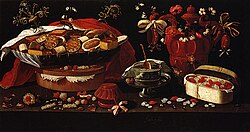
Fifty-fifty though Italian however-life painting (in Italian referred to as natura morta, "dead nature") was gaining in popularity, it remained historically less respected than the "k manner" painting of historical, religious, and mythic subjects. On the other manus, successful Italian yet-life artists constitute ample patronage in their twenty-four hours.[45] Furthermore, women painters, few as they were, normally chose or were restricted to painting notwithstanding life; Giovanna Garzoni, Laura Bernasconi, Maria Theresa van Thielen, and Fede Galizia are notable examples.[ citation needed ]
Many leading Italian artists in other genre, as well produced some withal-life paintings. In particular, Caravaggio practical his influential form of naturalism to still life. His Basket of Fruit (c. 1595–1600) is one of the offset examples of pure still life, precisely rendered and set at center level.[46] Though not overtly symbolic, this painting was owned by Cardinal Federico Borromeo and may take been appreciated for both religious and aesthetic reasons. Jan Bruegel painted his Large Milan Bouquet (1606) for the cardinal, besides, claiming that he painted it 'fatta tutti del natturel' (made all from nature) and he charged extra for the extra endeavour.[47] These were amidst many still-life paintings in the cardinal's collection, in addition to his large collection of curios. Among other Italian still life, Bernardo Strozzi'due south The Melt is a "kitchen scene" in the Dutch manner, which is both a detailed portrait of a cook and the game birds she is preparing.[48] In a like manner, one of Rembrandt'due south rare still-life paintings, Little Daughter with Dead Peacocks combines a similar sympathetic female portrait with images of game birds.[49]
In Catholic Italian republic and Spain, the pure vanitas painting was rare, and there were far fewer notwithstanding-life specialists. In Southern Europe in that location is more than employment of the soft naturalism of Caravaggio and less emphasis on hyper-realism in comparison with Northern European styles.[50] In France, painters of all the same lifes (nature morte) were influenced by both the Northern and Southern schools, borrowing from the vanitas paintings of kingdom of the netherlands and the spare arrangements of Spain.[51]
Italian gallery [edit]
Eighteenth century [edit]
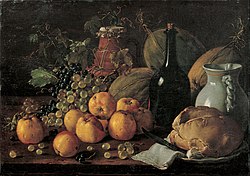
Luis Meléndez (1716–1780), Notwithstanding Life with Apples, Grapes, Melons, Bread, Jug and Canteen
The 18th century to a large extent continued to refine 17th-century formulae, and levels of production decreased. In the Rococo mode floral decoration became far more than common on porcelain, wallpaper, fabrics and carved wood effects, so that buyers preferred their paintings to accept figures for a contrast. 1 change was a new enthusiasm among French painters, who now class a large proportion of the most notable artists, while the English remained content to import. Jean-Baptiste Chardin painted small and uncomplicated assemblies of food and objects in a most subtle fashion that both built on the Dutch Gilded Age masters, and was to exist very influential on 19th-century compositions. Expressionless game subjects connected to be popular, particularly for hunting lodges; nigh specialists also painted live animal subjects. Jean-Baptiste Oudry combined superb renderings of the textures of fur and feather with elementary backgrounds, often the patently white of a lime-washed larder wall, that showed them off to advantage.[ citation needed ]
Past the 18th century, in many cases, the religious and allegorical connotations of yet-life paintings were dropped and kitchen table paintings evolved into calculated depictions of varied colour and form, displaying everyday foods. The French elite employed artists to execute paintings of bounteous and extravagant still-life subjects that graced their dining table, also without the moralistic vanitas message of their Dutch predecessors. The Rococo love of artifice led to a ascent in appreciation in France for trompe-l'œil (French: "trick the eye") painting. Jean-Baptiste Chardin's even so-life paintings employ a diverseness of techniques from Dutch-style realism to softer harmonies.[52]
The majority of Anne Vallayer-Coster'south work was devoted to the linguistic communication of still life every bit it had been adult in the course of the seventeenth and eighteenth centuries.[53] During these centuries, the genre of still life was placed lowest on the hierarchical ladder. Vallayer-Coster had a style about her paintings that resulted in their attractiveness. It was the "assuming, decorative lines of her compositions, the richness of her colours and simulated textures, and the feats of illusionism she accomplished in depicting broad diversity of objects, both natural and bogus"[53] which drew in the attention of the Royal Académie and the numerous collectors who purchased her paintings. This interaction between art and nature was quite common in Dutch, Flemish and French still lifes.[53] Her piece of work reveals the clear influence of Jean-Baptiste-Siméon Chardin, also as 17th-century Dutch masters, whose work has been far more highly valued, but what made Vallayer-Coster's style stand out against the other nevertheless-life painters was her unique fashion of coalescing representational illusionism with decorative compositional structures.[53] [54]
The end of the eighteenth century and the autumn of the French monarchy closed the doors on Vallayer-Coster's still-life 'era' and opened them to her new style of florals.[55] It has been argued that this was the highlight of her career and what she is all-time known for. Nevertheless, it has besides been argued that the flower paintings were futile to her career. Nevertheless, this collection independent floral studies in oil, watercolour and gouache.[55]
-
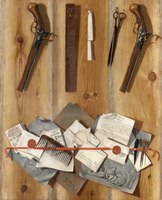
Carl Hofverberg (1695–1765), Trompe-l'œil (1737), Foundation of the Royal Armoury, Sweden
-

Rachel Ruysch, Roses, Convolvulus, Poppies, and Other Flowers in an Urn on a Stone Ledge (1680s)
Nineteenth century [edit]

With the rise of the European Academies, most notably the Académie française which held a fundamental role in Academic fine art, still life began to fall from favor. The Academies taught the doctrine of the "Hierarchy of genres" (or "Bureaucracy of Subject Matter"), which held that a painting's creative merit was based primarily on its bailiwick. In the Academic system, the highest form of painting consisted of images of historical, Biblical or mythological significance, with still-life subjects relegated to the very lowest guild of artistic recognition. Instead of using still life to glorify nature, some artists, such as John Constable and Camille Corot, chose landscapes to serve that end.[ citation needed ]
When Neoclassicism started to become into decline by the 1830s, genre and portrait painting became the focus for the Realist and Romantic artistic revolutions. Many of the great artists of that menstruation included even so life in their body of work. The yet-life paintings of Francisco Goya, Gustave Courbet, and Eugène Delacroix convey a strong emotional current, and are less concerned with exactitude and more interested in mood.[56] Though patterned on the earlier still-life subjects of Chardin, Édouard Manet'due south still-life paintings are strongly tonal and conspicuously headed toward Impressionism. Henri Fantin-Latour, using a more traditional technique, was famous for his exquisite flower paintings and made his living virtually exclusively painting nevertheless life for collectors.[57]
All the same, it was not until the last reject of the Academic bureaucracy in Europe, and the rise of the Impressionist and Post-Impressionist painters, that technique and colour harmony triumphed over subject matter, and that even so life was in one case once again avidly practiced past artists. In his early on still life, Claude Monet shows the influence of Fantin-Latour, but is 1 of the kickoff to interruption the tradition of the dark groundwork, which Pierre-Auguste Renoir also discards in Still Life with Boutonniere and Fan (1871), with its bright orangish background. With Impressionist yet life, emblematic and mythological content is completely absent, equally is meticulously detailed brush work. Impressionists instead focused on experimentation in broad, dabbing brush strokes, tonal values, and colour placement. The Impressionists and Mail-Impressionists were inspired by nature'southward colour schemes but reinterpreted nature with their own color harmonies, which sometimes proved startlingly unnaturalistic. As Gauguin stated, "Colours accept their own meanings."[58] Variations in perspective are also tried, such as using tight cropping and high angles, every bit with Fruit Displayed on a Stand past Gustave Caillebotte, a painting which was mocked at the time as a "display of fruit in a bird's-eye view."[59]
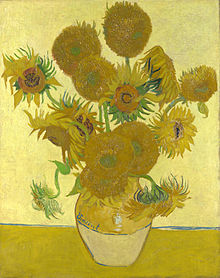
Vincent van Gogh's "Sunflowers" paintings are some of the best-known 19th-century still-life paintings. Van Gogh uses mostly tones of yellow and rather flat rendering to make a memorable contribution to nevertheless-life history. His Still Life with Cartoon Board (1889) is a self-portrait in still-life form, with Van Gogh depicting many items of his personal life, including his pipe, simple food (onions), an inspirational book, and a alphabetic character from his blood brother, all laid out on his table, without his own image present. He as well painted his own version of a vanitas painting Still Life with Open Bible, Candle, and Volume (1885).[58]
In the United States during Revolutionary times, American artists trained away applied European styles to American portrait painting and even so life. Charles Willson Peale founded a family of prominent American painters, and as major leader in the American art community, also founded a society for the training of artists as well every bit a famous museum of natural curiosities. His son Raphaelle Peale was one of a grouping of early American nonetheless-life artists, which also included John F. Francis, Charles Bird Male monarch, and John Johnston.[60] Past the second half of the 19th century, Martin Johnson Heade introduced the American version of the habitat or biotope picture, which placed flowers and birds in simulated outdoor environments.[61] The American trompe-l'œil paintings also flourished during this menstruation, created by John Haberle, William Michael Harnett, and John Frederick Peto. Peto specialized in the nostalgic wall-rack painting while Harnett accomplished the highest level of hyper-realism in his pictorial celebrations of American life through familiar objects.[62]
Nineteenth-century paintings [edit]
-

Henri Fantin-Latour, (1836–1904), White Roses, Chrysanthemums in a Vase, Peaches and Grapes on a Table with a White Tablecloth (1867)
-

Paul Cézanne (1839–1906), The Black Marble Clock (1869–1871), private collection
-

Twentieth century [edit]

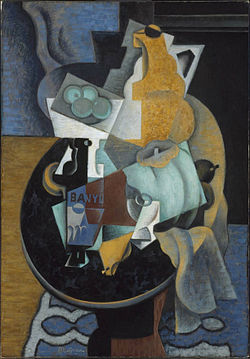
The offset four decades of the 20th century formed an exceptional menses of artistic ferment and revolution. Avant-garde movements rapidly evolved and overlapped in a march towards nonfigurative, total brainchild. The still life, as well every bit other representational art, continued to evolve and conform until mid-century when total abstraction, every bit exemplified by Jackson Pollock's drip paintings, eliminated all recognizable content.[ citation needed ]
The century began with several trends taking hold in art. In 1901, Paul Gauguin painted Still Life with Sunflowers, his homage to his friend Van Gogh who had died eleven years earlier. The group known as Les Nabis, including Pierre Bonnard and Édouard Vuillard, took upwards Gauguin's harmonic theories and added elements inspired past Japanese woodcuts to their all the same-life paintings. French creative person Odilon Redon also painted notable however life during this period, particularly flowers.[63]
Henri Matisse reduced the rendering of still-life objects even further to niggling more than bold, flat outlines filled with vivid colours. He also simplified perspective and introducing multi-colour backgrounds.[64] In some of his notwithstanding-life paintings, such as Nonetheless Life with Eggplants, his table of objects is nearly lost amongst the other colourful patterns filling the remainder of the room.[65] Other exponents of Fauvism, such as Maurice de Vlaminck and André Derain, further explored pure colour and abstraction in their still life.[ citation needed ]
Paul Cézanne found in all the same life the perfect vehicle for his revolutionary explorations in geometric spatial system. For Cézanne, withal life was a primary ways of taking painting abroad from an illustrative or mimetic function to one demonstrating independently the elements of color, class, and line, a major step towards Abstract art. Additionally, Cézanne'due south experiments can be seen as leading straight to the development of Cubist still life in the early on 20th century.[66]
Adapting Cézanne'due south shifting of planes and axes, the Cubists subdued the colour palette of the Fauves and focused instead on deconstructing objects into pure geometrical forms and planes. Between 1910 and 1920, Cubist artists like Pablo Picasso, Georges Braque, and Juan Gris painted many all the same-life compositions, often including musical instruments, bringing notwithstanding life to the forefront of artistic innovation, almost for the first time. Still life was too the subject area thing in the starting time Synthetic Cubist collage works, such every bit Picasso'due south oval "Still Life with Chair Caning" (1912). In these works, still-life objects overlap and intermingle barely maintaining identifiable ii-dimensional forms, losing private surface texture, and merging into the background—achieving goals nearly opposite to those of traditional still life.[67] Fernand Léger'south yet life introduced the use of arable white space and coloured, sharply defined, overlapping geometrical shapes to produce a more mechanical event.[68]
Rejecting the flattening of space by Cubists, Marcel Duchamp and other members of the Dada movement, went in a radically dissimilar management, creating 3-D "ready-made" still-life sculptures. As part of restoring some symbolic pregnant to however life, the Futurists and the Surrealists placed recognizable all the same-life objects in their dreamscapes. In Joan Miró's even so-life paintings, objects announced weightless and bladder in lightly suggested two-dimensional infinite, and fifty-fifty mountains are fatigued as unproblematic lines.[66] In Italy during this fourth dimension, Giorgio Morandi was the foremost still-life painter, exploring a wide diversity of approaches to depicting everyday bottles and kitchen implements.[69] Dutch artist M. C. Escher, best known for his detailed all the same ambiguous graphics, created Still life and Street (1937), his updated version of the traditional Dutch table still life.[70] In England Eliot Hodgkin was using tempera for his highly detailed still-life paintings.[ citation needed ]
When 20th-century American artists became aware of European Modernism, they began to translate however-life subjects with a combination of American realism and Cubist-derived abstraction. Typical of the American still-life works of this period are the paintings of Georgia O'Keeffe, Stuart Davis, and Marsden Hartley, and the photographs of Edward Weston. O'Keeffe'southward ultra-closeup bloom paintings reveal both the concrete structure and the emotional subtext of petals and leaves in an unprecedented way.[ citation needed ]
In Mexico, starting in the 1930s, Frida Kahlo and other artists created their own brand of Surrealism, featuring native foods and cultural motifs in their still-life paintings.[71]
Starting in the 1930s, abstract expressionism severely reduced still life to raw depictions of form and colour, until past the 1950s, total brainchild dominated the fine art world. Yet, pop art in the 1960s and 1970s reversed the trend and created a new class of nevertheless life. Much pop fine art (such as Andy Warhol's "Campbell's Soup Cans") is based on still life, but its true subject is nearly often the commodified image of the commercial product represented rather than the concrete all the same-life object itself. Roy Lichtenstein's Still Life with Goldfish Bowl (1972) combines the pure colours of Matisse with the pop iconography of Warhol. Wayne Thiebaud's Lunch Tabular array (1964) portrays not a single family's dejeuner but an assembly line of standardized American foods.[72]
The Neo-dada movement, including Jasper Johns, returned to Duchamp'due south iii-dimensional representation of everyday household objects to create their own brand of however-life work, as in Johns' Painted Bronze (1960) and Fool'southward Firm (1962).[73] Avigdor Arikha, who began as an abstractionist, integrated the lessons of Piet Mondrian into his nonetheless lifes as into his other work; while reconnecting to quondam primary traditions, he achieved a modernist formalism, working in one session and in natural light, through which the subject-thing often emerged in a surprising perspective.[ citation needed ]
A significant contribution to the development of nonetheless-life painting in the 20th century was fabricated by Russian artists, amidst them Sergei Ocipov, Victor Teterin, Evgenia Antipova, Gevork Kotiantz, Sergei Zakharov, Taisia Afonina, Maya Kopitseva, and others.[74]
By contrast, the rise of Photorealism in the 1970s reasserted illusionistic representation, while retaining some of Pop's bulletin of the fusion of object, image, and commercial product. Typical in this regard are the paintings of Don Eddy and Ralph Goings.[ commendation needed ]
Twentieth-century paintings [edit]


21st century [edit]

During the 20th and 21st centuries, the notion of the still life has been extended across the traditional two dimensional fine art forms of painting into video art and three dimensional art forms such as sculpture, performance and installation. Some mixed media yet-life works use found objects, photography, video, and sound, and even spill out from ceiling to flooring and fill an unabridged room in a gallery. Through video, still-life artists have incorporated the viewer into their work. Post-obit from the estimator historic period with computer art and digital art, the notion of the still life has besides included digital engineering science. Computer-generated graphics have potentially increased the techniques available to still-life artists. 3D calculator graphics and 2D computer graphics with 3D photorealistic effects are used to generate constructed notwithstanding life images. For example, graphic art software includes filters that can be applied to 2D vector graphics or second raster graphics on transparent layers. Visual artists have copied or visualised 3D effects to manually render photorealistic effects without the utilise of filters.[ citation needed ]
See also [edit]
- Dutch Golden Age painting
- List of Dutch painters
- Vanitas
- Memento Mori
- All the same life photography
Notes [edit]
- ^ Langmuir, six
- ^ Langmuir, 13–14
- ^ Langmuir, 13–fourteen and preceding pages
- ^ Volume XXXV.112 of Natural History
- ^ Ebert-Schifferer, p. xix
- ^ Ebert-Schifferer, p.22
- ^ Ebert-Schifferer, p.137
- ^ a b Ebert-Schifferer, p. sixteen
- ^ a b Ebert-Schifferer, p. 15
- ^ Memlings Portraits exhibition review, Frick Collection, NYC. Retrieved March 15, 2010.
- ^ Ebert-Schifferer, p.25
- ^ Ebert-Schifferer, p. 27
- ^ Ebert-Schifferer, p. 26
- ^ Ebert-Schifferer, p. 39, 53
- ^ Ebert-Schifferer, p. 41
- ^ Ebert-Schifferer, p. 31
- ^ Ebert-Schifferer, p. 34
- ^ Slive, 275; Vlieghe, 211–216
- ^ Ebert-Schifferer, p. 45
- ^ Ebert-Schifferer, p. 47
- ^ Ebert-Schifferer, p.38
- ^ Ebert-Schifferer, pp. 54–56
- ^ Ebert-Schifferer, p. 64
- ^ Ebert-Schifferer, p. 75
- ^ Metropolitan Museum of Art Timeline, Even so-life painting 1600–1800. Retrieved March xiv, 2010.
- ^ Books.google.co.uk, translation
- ^ Slive 277–279
- ^ Vlieghe, 207
- ^ Slive, 279, Vlieghe, 206-7
- ^ Paul Taylor, Dutch Flower Painting 1600–1720, Yale Academy Printing, New Haven, 1995, p. 77, ISBN 0-300-05390-8
- ^ Taylor, p. 129
- ^ Taylor, p. 197
- ^ Taylor, pp. 56–76
- ^ Ebert-Schifferer, p. 93
- ^ Susan Merriam, Seventeenth-century Flemish Garland Paintings: All the same Life, Vision, and the Devotional Image, Ashgate Publishing, Ltd., 2012
- ^ Oxford Dictionary of Fine art Terms: Pronkstilleven
- ^ Ebert-Schifferer, p. 90
- ^ Ebert-Schifferer, p. 164
- ^ Ebert-Schifferer, p. 170
- ^ Ebert-Schifferer, pp. 180–181
- ^ See Juan van der Hamen.
- ^ Zuffi, p. 260
- ^ Lucie-Smith, Edward (1984). The Thames and Hudson Dictionary of Art Terms . London: Thames and Hudson. p. 32. ISBN9780500233894. LCCN 83-51331
- ^ Ebert-Schifferer, p. 71
- ^ La natura morta in Italia edited by Francesco Porzio and directed by Federico Zeri; Review author: John T. Spike. The Burlington Magazine (1991) Volume 133 (1055) page 124–125.
- ^ Ebert-Schifferer, p. 82
- ^ Ebert-Schifferer, p. 84
- ^ Stefano Zuffi, Ed., Baroque Painting, Barron's Educational Serial, Hauppauge, New York, 1999, p. 96, ISBN 0-7641-5214-9
- ^ Zuffi, p. 175
- ^ Ebert-Schifferer, p. 173
- ^ Ebert-Schifferer, p. 229
- ^ Zuffi, p. 288, 298
- ^ a b c d Michel 1960, p. i
- ^ Berman 2003
- ^ a b Michel 1960, p. ii
- ^ Ebert-Schifferer, p. 287
- ^ Ebert-Schifferer, p. 299
- ^ a b Ebert-Schifferer, p. 318
- ^ Ebert-Schifferer, p. 310
- ^ Ebert-Schifferer, p. 260
- ^ Ebert-Schifferer, p. 267
- ^ Ebert-Schifferer, p. 272
- ^ Ebert-Schifferer, p. 321
- ^ Ebert-Schifferer, pp. 323–4
- ^ Stefano Zuffi, Ed., Modern Painting, Barron'southward Educational Serial, Hauppauge, New York, 1998, p. 273, ISBN 0-7641-5119-3
- ^ a b Ebert-Schifferer, p. 311
- ^ Ebert-Schifferer, p. 338
- ^ David Piper, The Illustrated Library of Art, Portland Business firm, New York, 1986, p. 643, ISBN 0-517-62336-6
- ^ David Piper, p. 635
- ^ Piper, p. 639
- ^ Ebert-Schifferer, p. 387
- ^ Ebert-Schifferer, pp. 382–three
- ^ Ebert-Schifferer, p. 384-6
- ^ Sergei V. Ivanov, Unknown Socialist Realism. The Leningrad School. – Saint Petersburg: NP-Print Edition, 2007. – 448 p. ISBN 5-901724-21-half dozen, ISBN 978-5-901724-21-7.
References [edit]
- Berman, Greta. "Focus on Art". The Juilliard Journal Online 18:6 (March 2003)
- Ebert-Schifferer, Sybille. Still Life: A History, Harry Northward. Abrams, New York, 1998, ISBN 0-8109-4190-ii
- Langmuir, Erica, Nonetheless Life, 2001, National Gallery (London), ISBN 1857099613
- Michel, Marianne Roland. "Tapestries on Designs by Anne Vallayer-Coster." The Burlington Magazine 102: 692 (Nov 1960): i–two
- Slive, Seymour, Dutch Painting, 1600–1800, Yale University Press, 1995, ISBN 0-300-07451-4
- Vlieghe, Hans (1998). Flemish Art and Architecture, 1585–1700. Yale University Press Pelican history of fine art. New Haven: Yale University Press. ISBN 0-300-07038-1
External links [edit]
-
 Media related to Notwithstanding-life paintings at Wikimedia Commons
thorntonthroplad1935.blogspot.com
Source: https://en.wikipedia.org/wiki/Still_life

Post a Comment for "Clip Art Pictures of Fruit Spilled Apples Black and"