Which Pieces of Art Truly Represent Vincent Van Gogh Creativity
Self-Portraits by Van Gogh


The fervor and fragility of Van Gogh's life are told on this canvas by stark contrasts of color and restless brushstrokes. Heavy lines of paint seem to emanate from his head like a wavering force field, energized by his own intensity. This background sets off the complementary colors of his green-tinged face and orange pilus, keying his image to a higher pitch. "I was thin and pale as a ghost," Van Gogh wrote as he described this portrait to Théo. "Information technology is dark violet bluish and the head whitish with xanthous pilus, and then it has a color effect."
Van Gogh worked on a 2d self-portrait at about the aforementioned time. Although its background is animated with swirling brushstrokes, the more muted color scheme lends the prototype a calmer aspect. The creative person believed, nonetheless, that the painting seen hither captured his "truthful character."
About the Artist

Henri de Toulouse-Lautrec, Vincent van Gogh, 1887. Van Gogh Museum, Amsterdam (Vincent van Gogh Foundation), d693V/1962.
Vincent van Gogh grew upwards in the southern Netherlands, where his begetter was a government minister. Later on seven years at a commercial art firm, Van Gogh'due south desire to help humanity led him to become a teacher, preacher, and missionary—nonetheless without success. Working equally a missionary among coal miners in Belgium, he had begun to depict in earnest; finally, dismissed by church building authorities in 1880, he found his vocation in fine art.
Van Gogh'southward earliest paintings were earth-toned scenes of nature and peasants, but he became increasingly influenced by Japanese prints and the work of the impressionists in France. In 1886 he arrived in Paris, where his real formation equally a painter began. Under the influence of Camille Pissarro, Van Gogh brightened his somber palette and juxtaposed complementary colors for luminous effect. Younger artists like Henri de Toulouse-Lautrec and Paul Gauguin prompted him to employ color symbolically and for its emotional resonance.
Although stimulated past the city's artistic environs, Van Gogh found life in Paris physically exhausting and moved in early on 1888 to Arles. He hoped Provence's warm climate would relax him and that the bright colors and strong light of the south would provide inspiration for his art. Working feverishly, Van Gogh pushed his style to greater expression with intense, energetic brushwork and saturated, complementary colors. Nevertheless his densely painted canvases remained connected to nature—their colors and rhythmic surfaces communicate the spiritual power he believed inhabited and shaped nature's forms. His activity was not undisciplined; quite the contrary, he worked diligently to perfect his craft.
Van Gogh hoped to attract like-minded painters to Arles, only only Gauguin joined him, staying almost two months. It was before long clear that their personalities and artistic temperaments were incompatible, and Van Gogh suffered a breakdown just earlier Christmas. In April, following periods of intense work interrupted by recurring mental disturbances, Van Gogh committed himself to a sanitarium in St.-Rémy. He painted whenever he could, assertive that in work lay his but chance for sanity. Subsequently a twelvemonth, he returned north to be closer to his brother Théo, who had been his constant back up; in July he died of a cocky-inflicted gunshot wound.
More Works from the Collection

Judith Leyster, Self-Portrait, c. 1630, oil on canvas, Souvenir of Mr. and Mrs. Robert Woods Bliss, 1949.six.i
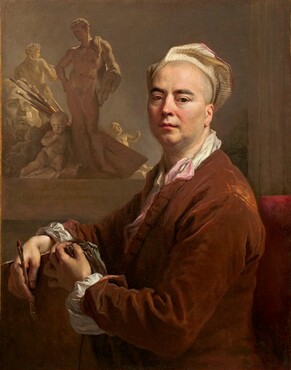
Nicolas de Largillierre, Self-Portrait, 1707, oil on sail, Patrons' Permanent Fund, 2006.26.1
thorntonthroplad1935.blogspot.com
Source: https://www.nga.gov/collection/highlights/van-gogh-self-portrait.html

Post a Comment for "Which Pieces of Art Truly Represent Vincent Van Gogh Creativity"